
Advances in Biocomputation and Goal-Directed Learning
Human Brain Cells Learn to Play Classic Game Doom
Australian startup Cortical Labs demonstrates goal-directed learning in biological tissue using 200,000 neurons.
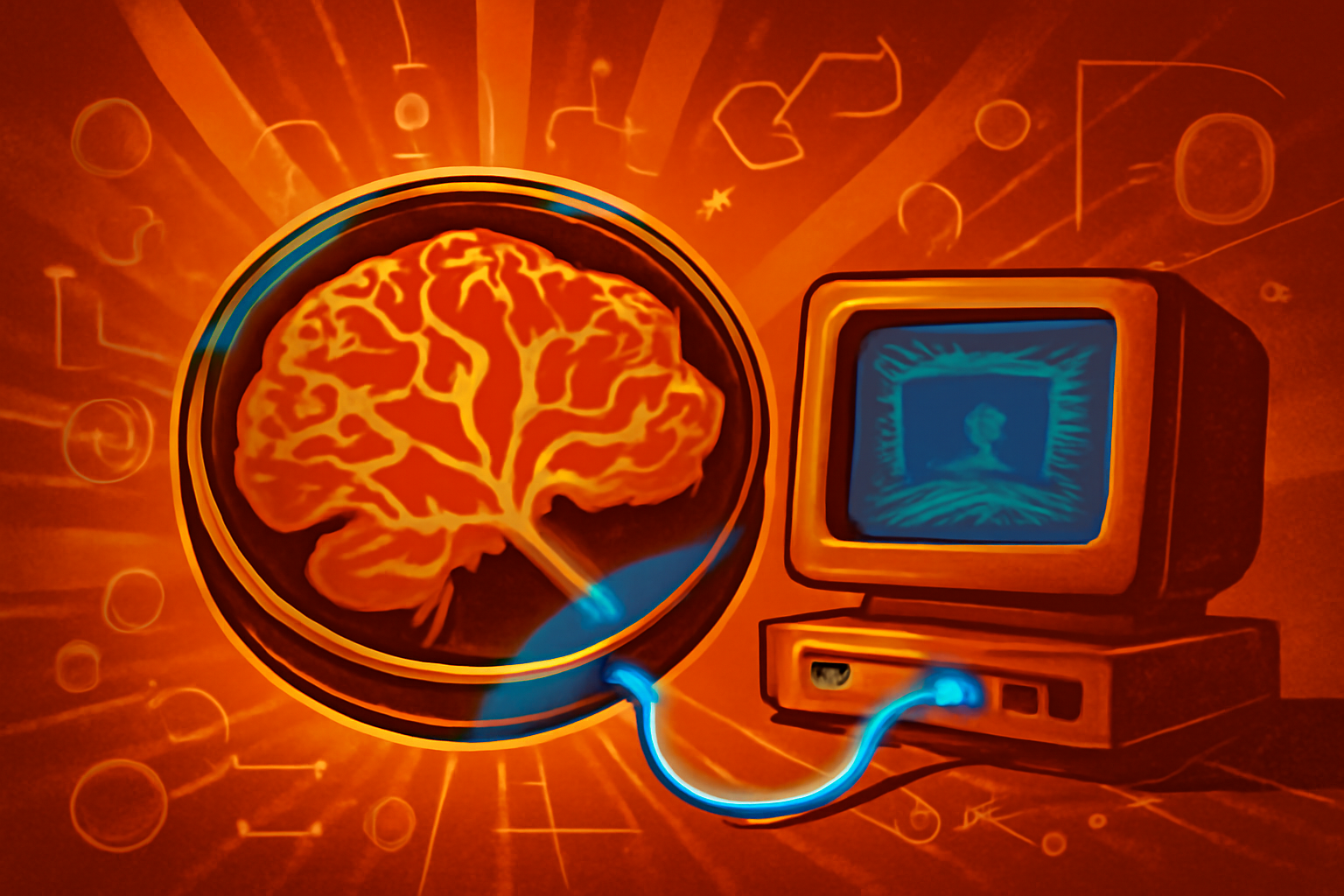
A close-up of a microelectrode array holding lab-grown human neurons in a petri dish, positioned in front of a computer screen displaying a classic video game.
Photo: Avantgarde News
Scientists at Australian startup Cortical Labs have successfully trained a biological computer to play the 1993 shooter game Doom [1]. This system consists of approximately 200,000 lab-grown human brain cells, or neurons, integrated into a digital interface [2]. The research demonstrates that biological tissue can achieve goal-directed learning in a controlled environment [1][3]. The neurons interact with the game by receiving electrical feedback based on their performance [2]. When the cells successfully hit a target, they receive a structured signal, whereas failure results in random noise [3]. This "DishBrain" technology highlights the potential for biocomputation to eventually outperform traditional silicon-based chips in specific tasks [1]. Researchers aim to use these biological computers to study neurological disorders and drug responses [2]. While the technology is in its early stages, it marks a significant step in developing more efficient and adaptive computing systems [3].
Editorial notes
Transparency note
Drafted with LLM; human-edited
- AI assisted
- Yes
- Human review
- Yes
- Last updated
Risk assessment
Reviewed for sourcing quality and editorial consistency.
Sources
- 1.↗
theguardian.com
https://www.theguardian.com/games/2026/mar/16/petri-dish-brain-cells-playing-doom-cortical-labs
- 2.↗
military.com
https://www.military.com/feature/2026/03/10/scientists-teach-human-brain-cells-play-doom-sci-fi-experiment.html
- 3.↗
rnz.co.nz
https://www.rnz.co.nz/news/world/589269/researchers-teach-computer-made-from-human-brain-cells-to-play-doom
Related stories
View all


Topics
About the author
Avantgarde News Desk covers advances in biocomputation and goal-directed learning and editorial analysis for Avantgarde News.