
Revolutionary Imaging of the Cosmic Dawn
China Debuts ASTERIS AI to Map Deep Space Galaxies
Tsinghua researchers unveil an AI model identifying galaxies from the Cosmic Dawn, 13 billion light-years away.
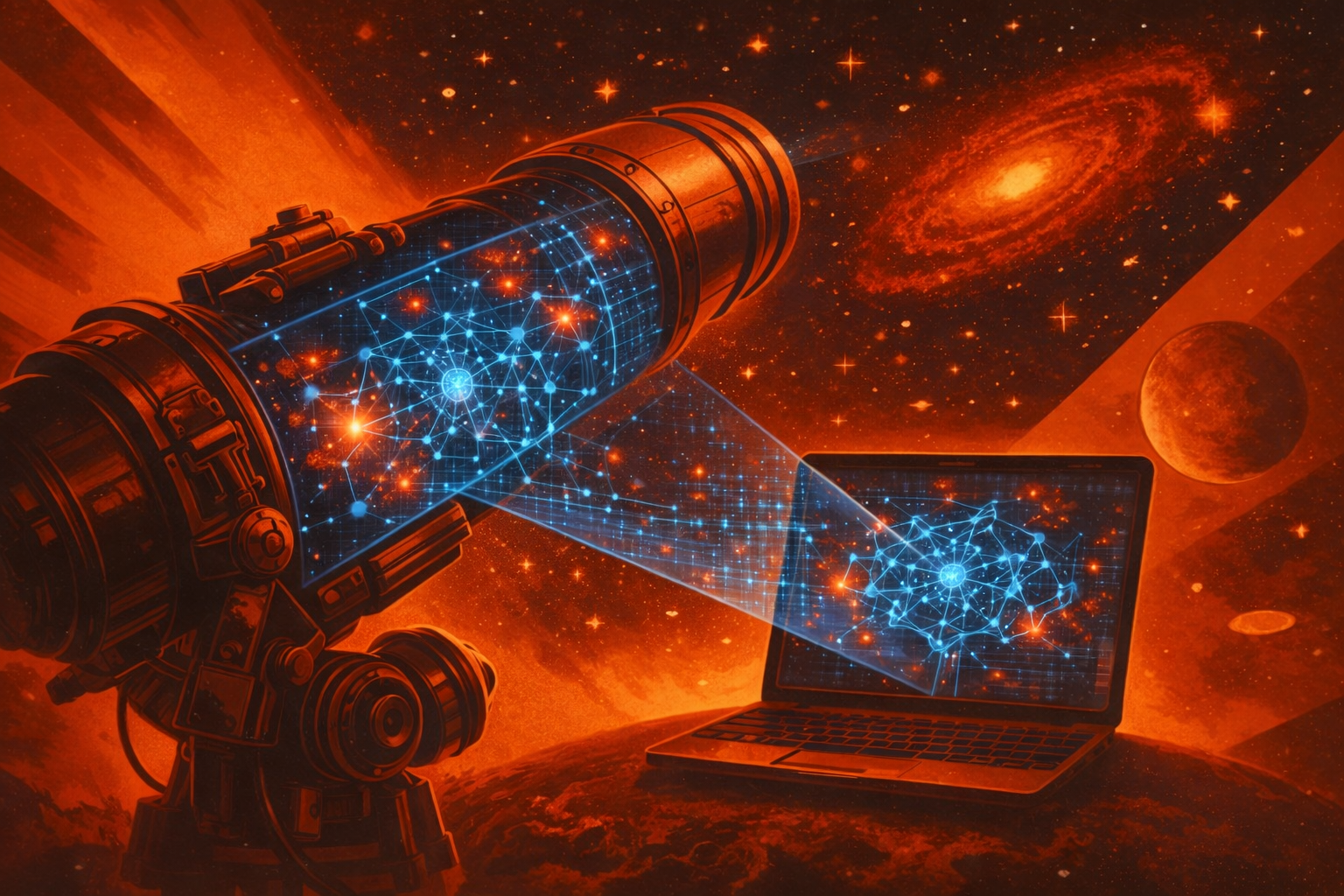
An editorial visualization of a space telescope focusing on distant red galaxies with a semi-transparent blue digital overlay representing artificial intelligence data analysis.
Photo: Avantgarde News
A cross-disciplinary team from Tsinghua University has unveiled ASTERIS, an AI model designed for deep-space imaging [1][2]. Published in the journal Science, the model decodes massive volumes of telescope data to identify galaxies over 13 billion light-years away [2][3]. ASTERIS, or Astronomical Spatiotemporal Enhancement and Reconstruction for Image Synthesis, uses computational optics to detect faint signals previously obscured by cosmic noise [1][2]. The technology enhances the James Webb Space Telescope’s detection depth by 1.0 magnitude, allowing it to find objects 2.5 times fainter than before [2][3]. Using this model, researchers identified more than 160 candidate galaxies from the "Cosmic Dawn" period [1][3]. Scientists say ASTERIS could become a universal platform for next-generation astronomical research by significantly speeding up data analysis [2][3].
Editorial notes
Transparency note
Drafted with LLM; human-edited
- AI assisted
- Yes
- Human review
- Yes
- Last updated
Risk assessment
Reviewed for sourcing quality and editorial consistency.
Sources
- 1.↗
thenews.com.pk
https://www.thenews.com.pk/latest/1393224-chinese-scientists-unveil-advanced-ai-model-to-support-deep-space-exploration
- 2.↗
chinadaily.com.cn
https://www.chinadaily.com.cn/a/202602/21/WS69990edda310d6866eb39b23.html
- 3.↗
english.news.cn
https://english.news.cn/20260220/41d8f76ebf8e47b4913e9ee454f5ff6e/c.html
Related stories
View all


Topics
About the author
Avantgarde News Desk covers revolutionary imaging of the cosmic dawn and editorial analysis for Avantgarde News.